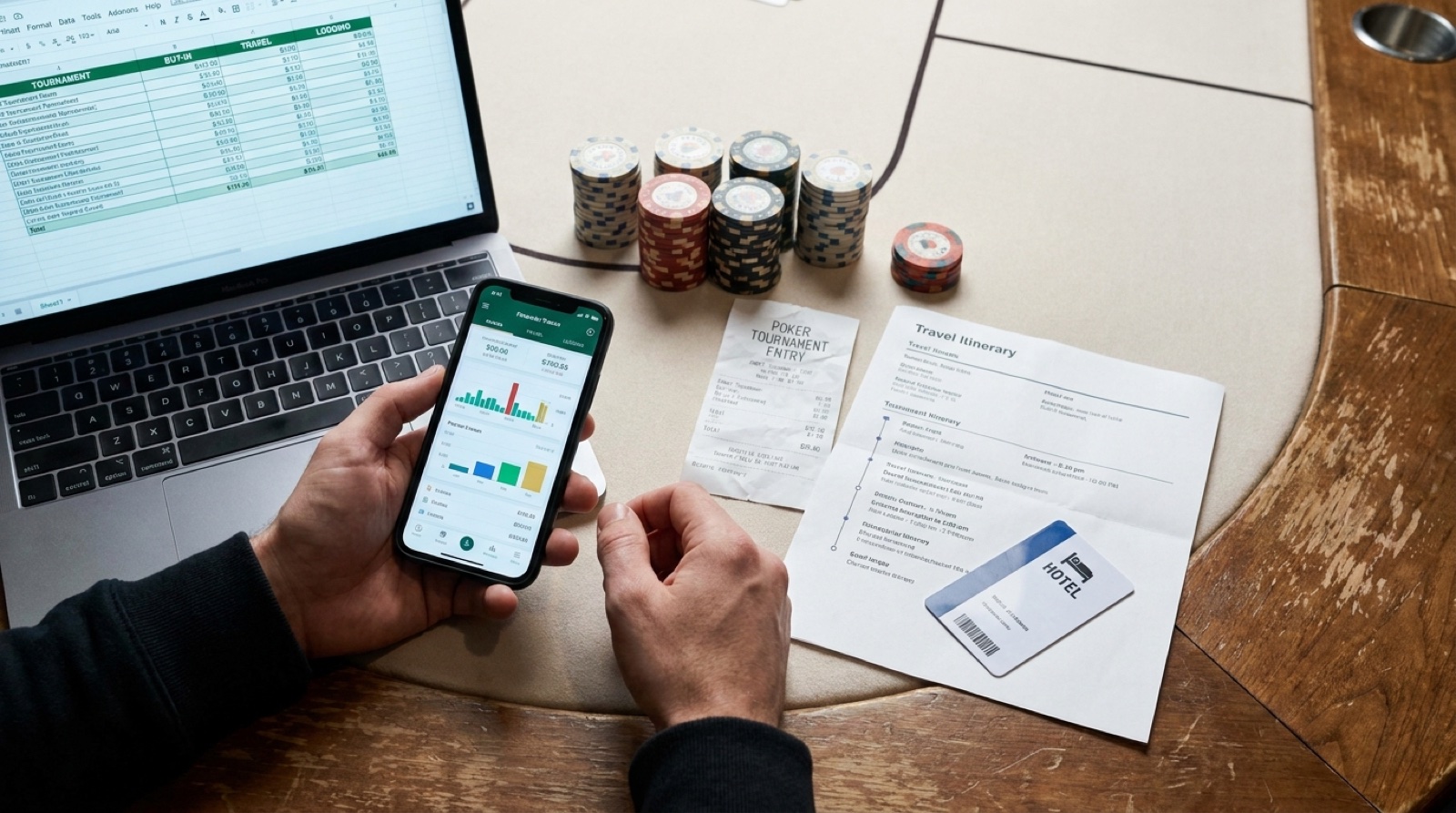
 Tournament bankroll tracker: buy-ins, re-entries, and travel costs
A smart late registration strategy starts with a blunt question: what do you give up when you sit down late, and is the trade worth it for your bankroll?
If you only track cashes, late registration can look better than it is. You save two hours, maybe ladder into a min-cash, and tell yourself the spot was good. If you track every buy-in, fee, re-entry, travel cost, and bustout time in Poker Stack, the picture gets colder. Some late-reg spots are good. Some are short-stack punts with a receipt.
What changes when you register late?
Late registration lets you join after the tournament has started. The Poker TDA rules say late registrants and re-entries are sold full stacks and draw seats through the same random seating process as new players. That sounds simple, but the blinds have moved while your stack stayed fixed.
That means your starting stack in chips may be the same as everyone else had at the start, while your starting stack in big blinds is smaller. A 30,000-chip stack is one thing at 100/200. It is a different job at 1,000/2,000 with antes.
The later you enter, the more your tournament becomes a short-stack exercise. You lose some chances to play deep against weaker players. You gain time and sometimes get closer to the money. The whole decision lives in that trade.
Freezeouts make the cost cleaner
A freezeout is easier to budget because one entry is one shot. The Lodge explains freezeouts as tournaments where your run ends when you lose your chips, unlike re-entry and rebuy events where you can buy back in.
That fixed cost matters. If the buy-in is $300 plus a $30 fee, your downside is clear before you sit down. You can ask whether that one bullet fits your roll, whether the field is soft enough, and whether the structure gives you enough play.
Re-entry events feel more flexible, but they can hide the real spend. A $300 event with two bullets is not a $300 test. It is a $600 or $660 tournament day before travel, food, and swaps. If you track tournaments in Poker Stack, log every bullet as part of the same event so your ROI does not lie to you, then compare the spot against the broader online poker tournament strategy guide.
When late registration can be good
Late registration can make sense when your time is valuable, the structure still gives you a playable stack, and the field has not turned into a reg-heavy short-stack fight. It can also make sense near the money in some online events, where you buy in close enough to the bubble that survival has immediate value.
Upswing Poker's late registration guide argues that later entries tend to lower ROI and raise variance, while very late entries near the money can still have value in some formats. That is the point most players skip. A late buy-in needs a reason beyond impatience.
- You still enter with enough big blinds to use your edge.
- The event is soft enough that skipping early levels does not cost too much.
- You are strong with 10 to 30 big blinds.
- The payout and late-reg clock create real bubble pressure.
- Your bankroll can handle the extra variance.
When freezeout entry is better
Early entry is usually better when your edge comes from patience, table reads, and deep-stack mistakes from weaker players. You get more hands. You see who is splashing. You build history before the blinds force everyone into push-fold spots.
Freezeouts also protect players from one of the ugliest leaks in tournament poker: pretending the second bullet is free. If you tend to fire re-entries because you are annoyed, a freezeout is a useful cage. You have one buy-in, so you treat it like one buy-in.
This is why freezeouts can be better for players trying to measure honest ROI. The format makes your cost visible. A re-entry event can still be profitable, but you need to track the real number of bullets, not the advertised buy-in.
Use bankroll rules before structure opinions
Structure opinions are cheap. Bankroll rules force the truth. Tournament variance is brutal even for winning players. Primedope's tournament variance simulator says a winning MTT player with a 30% ROI can still go 200 or more tournaments without a meaningful cash. GTO Wizard's bankroll guide also points out that tournament players face higher variance than cash-game players.

Download Poker Stack Now
"PokerStack is THE app you need to have as a live poker player."
Poker.com


That is why late registration needs a bigger cushion. You may cash more often in some narrow spots, but you also start closer to all-in decisions. If your edge is small, a short-stack late entry can turn a good tournament into a high-variance lottery ticket.
Before you register, write down the full cost:
- Buy-in and fee
- Maximum bullets you are willing to fire
- Travel, food, and parking if it is live
- Expected time in the event
- Current bankroll after the buy-in is gone
If you cannot write that down calmly, skip the event or play a smaller one. Your bankroll does not care that the guarantee looked juicy.
A simple late-reg decision checklist
Use this before the next tournament:
- How many big blinds do I get? Forty big blinds is a poker tournament. Twelve big blinds is a shove chart with hope attached.
- How soft is the remaining field? If the early splashers are gone, your edge may be smaller than usual.
- How close is the money? Near-bubble late reg can change the math, but only if the structure and payout make survival valuable.
- How many bullets am I really allowing? Decide before you bust, not while you are tilted.
- Will I review the result? If you do not track it, you will remember the close calls and forget the quiet punts.
The last question is where most players fool themselves. A late entry that ends in a min-cash feels smart. Five late entries that bleed fees over a month feel invisible unless you track them.
Track late reg and freezeouts as separate habits
Do not lump every tournament into one messy result. In a tournament bankroll tracker, tag late-reg events, freezeouts, re-entry events, and travel-heavy tournaments separately. Over time, you can compare what actually makes money for you.
You may learn that max late reg is good for one online series and terrible for local live events. You may learn that freezeouts suit your style because you make better decisions when there is no reload button. You may also learn that your best ROI comes from boring, on-time entries in soft fields.
That is useful information. It beats table talk and memory.
The practical answer
Choose freezeouts or early entry when you want lower cost clarity, more deep-stack hands, and a cleaner read on your edge. Choose late registration only when the stack, field, payout, and bankroll cushion all support it.
If the only reason is that you do not want to sit through Level 1, call it what it is. You are buying convenience. Sometimes that is fine. Just do not confuse it with better ROI until your results prove it.
Related Poker Stack reading
Tournament bankroll tracker: buy-ins, re-entries, and travel costs Poker satellite strategy: when folding aces preflop is right
 Mystery bounty psychology: do not be a lottery player
 Poker trip budget: before you book the flight, track the real cost
Read our blog