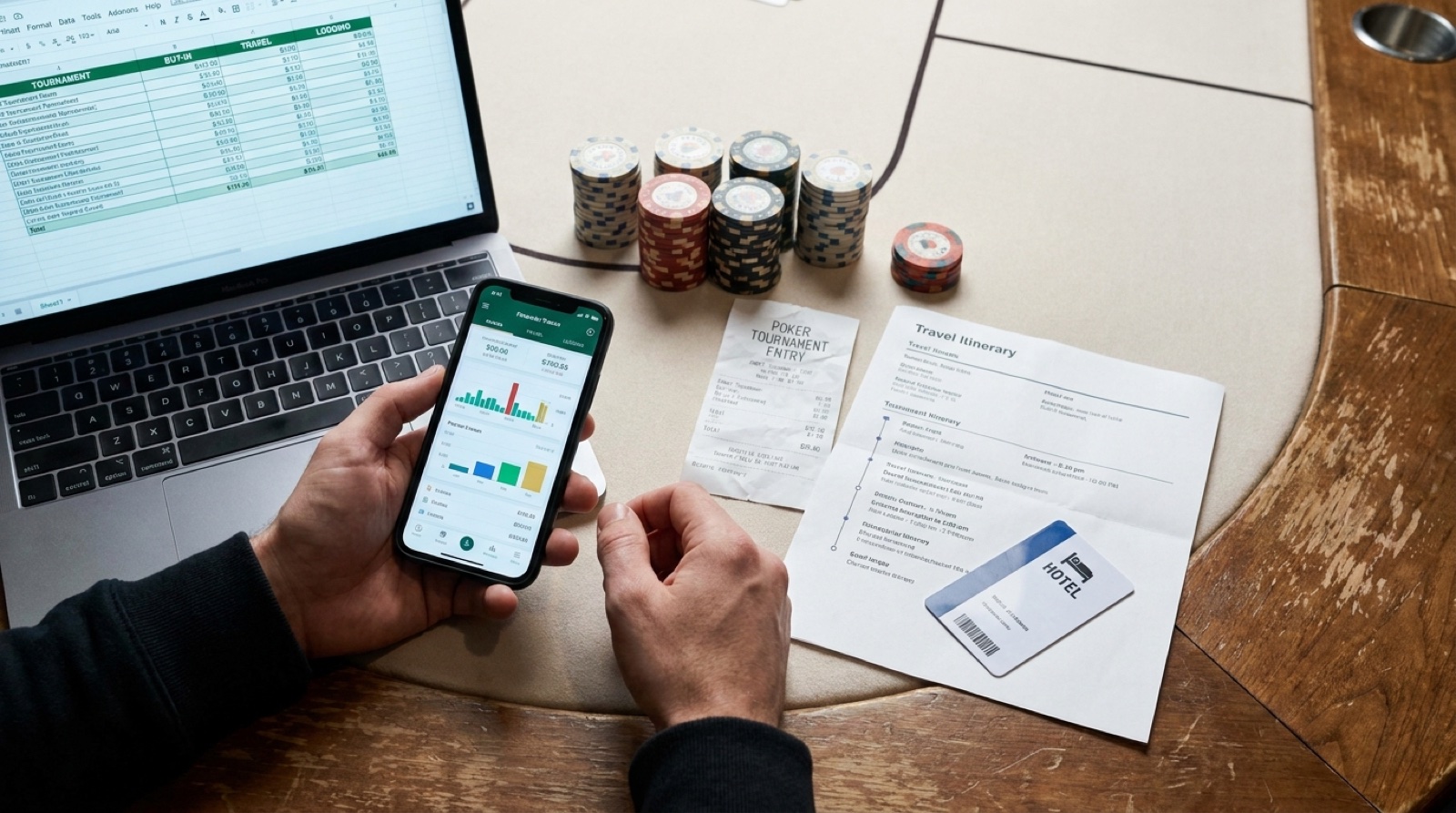
 Tournament bankroll tracker: buy-ins, re-entries, and travel costs
A poker staking tracker keeps you honest when tournament money gets split between buyers, backers, swaps, markup, makeup, re-entries, and expenses. Gross cashes feel good, but they do not tell you what you actually owned.
If you sell half your action, swap 10 percent with two friends, fire a second bullet, and split hotel costs, the lobby result is only the start of the record. Your bankroll needs the real number.
This is not legal, tax, or contract advice. Poker staking deals can get serious fast. Use proper advice for contracts, disputes, taxes, and reporting. This guide is about the tracking habit: what to record so your bankroll, tournament ROI, and next decision are not built on memory.
Track your own results: The Poker bankroll tracker app guide explains how Poker Stack turns session records into a repeatable bankroll review, not a stack of half-remembered poker receipts.
Start with ownership, not the cash
Most tournament players remember the cash amount first. That is backwards when action is sold or swapped. Start with ownership.
Write down how much of yourself you kept before the tournament starts. If you sold 30 percent, you kept 70 percent. If you swapped 5 percent with another player, keep that separate from sold action because it depends on someone else's result too.
PokerNews defines staking as one player putting up money for another player in exchange for a share of winnings. That simple idea creates messy records if you do not write the deal down before the first hand.
| Item | Example | Why it matters |
|---|---|---|
| Your retained action | 70% | Shows how much of your own result hits your bankroll. |
| Sold action | 30% | Shows what belongs to buyers after a cash. |
| Swaps | 5% with two players | Creates extra wins or losses outside your own finish. |
| Backing deal | Backer pays buy-ins | Changes who carries the cost and how profit is split. |
The table can live in a spreadsheet, a note, or your bankroll app. The format matters less than the discipline. Record the deal before the result changes how everyone remembers it.
Track buy-ins and re-entries as real exposure
A staking record without bullet count is weak. A player can sell action for one entry, then re-enter twice and create a different risk profile than buyers expected.
For each event, record:
- Event name, venue, and date.
- Buy-in and fee.
- How many bullets were included in the deal.
- Actual bullets fired.
- Add-ons, bounties, or admin fees.
- Who paid each entry.
- Whether re-entries change the ownership split.
This connects directly to tournament bankroll tracking. Re-entries are not a footnote. They are part of the cost basis. If you do not log them cleanly, your ROI will look better than your bankroll feels.
Do not let markup hide the real price
Markup is where poker players start mixing poker skill with sales math. If a player sells 10 percent of a $1,000 event at 1.2 markup, the buyer pays $120 for 10 percent. The player gets extra money up front because the package is priced above face value.
PokerNews defines markup as the premium charged over the straight buy-in share. That premium matters because it changes buyer break-even and seller bankroll impact.
Log markup in its own field. Do not bury it inside the buy-in. A clean record should show:
- Face value of the package.
- Markup rate.
- Amount each buyer paid.
- Actual percentage each buyer owns.
- Whether unused bullets are refunded.
Example: you sell 25 percent of a $2,000 package at 1.15 markup. Buyers pay $575 total for that 25 percent. They still own 25 percent of the result, not 28.75 percent. The extra $75 is markup, and your tracker should show it as separate money.
Makeup needs its own running balance
Backing deals often include makeup. In plain language, makeup is the amount a backed player must recover before profit splits start again. It can turn a good-looking cash into a smaller personal win because past losses get cleared first.
Keep makeup away from normal profit/loss. Use a running balance:
| Event | Result after costs | Makeup before | Makeup after | Player profit paid |
|---|---|---|---|---|
| $1,100 Main | -$1,100 | $0 | $1,100 | $0 |
| $550 Side event | +$900 | $1,100 | $200 | $0 |
| $330 Turbo | +$1,200 | $200 | $0 | Split remaining $1,000 |
This is the part many players misread. The tournament result can be positive while your personal bankroll does not move yet. A tracker should make that obvious before you decide to play bigger.
Separate tournament profit from package profit
Your own tournament result and your package result are related, but they are not the same record.
Use two lines when needed:
- Event result: buy-ins, fees, re-entries, cash, and expenses.
- Ownership result: your retained share, sold action owed, swaps won or lost, backing split, and makeup movement.

Download Poker Stack Now
"PokerStack is THE app you need to have as a live poker player."
Poker.com


That separation protects you from the common mistake: posting a big cash in your mind while the actual bankroll increase is much smaller. It also helps when you review whether the package was worth selling at all.
If you are already using session notes, add a short staking note beside the numbers. Something like: Sold 35 percent, kept 65 percent, two bullets included, no swaps, travel paid personally. That one line prevents a lot of future guessing.
Bought action belongs in your bankroll too
Buying pieces is gambling with your poker bankroll, even when you are not the one playing the hand. Track it like a poker investment, not like a random payment to a friend.
For each piece you buy, record:
- Player name or private label.
- Event and date.
- Percentage bought.
- Markup paid.
- Total cost.
- Result paid back.
- Any delay or dispute note.
This matters most when you buy small pieces often. Ten tiny swaps and pieces can distort your month. You may think your tournament results are flat when your bought action is quietly losing, or the other way around.
Use a simple staking tracker layout
A good poker staking tracker does not need to be pretty. It needs to answer four questions fast.
- How much did I put at risk?
- How much of my own result did I keep?
- How much do I owe or collect from other people?
- What changed in my bankroll after everything cleared?
Here is the cleanest layout:
| Field | What to write |
|---|---|
| Event cost | Buy-in, fee, bullets, add-ons, and direct expenses. |
| Action kept | Your retained percentage. |
| Action sold | Each buyer, percentage, markup, and paid amount. |
| Swaps | Player, event, percentage, and final amount owed. |
| Backing | Who paid, profit split, makeup before, makeup after. |
| Settlement | Paid, pending, refunded, or disputed. |
| Bankroll change | The final personal bankroll movement after all splits. |
Competitor tools show the same broad market need from different angles. Poker Analytics focuses on bankroll statistics, filters, and hand review. Poker Bankroll Tracker presents session tracking, graphs, and variance tools. PokerNews lists bankroll tracker apps for players who want better records. For staking, the missing piece is usually ownership math and settlement status.
Review staking like a bankroll leak
After 10 to 20 backed or staked events, review the pattern. Do not only ask whether you had a big score. Ask whether the structure helped your bankroll.
- Are you selling too much of yourself in soft events?
- Are you keeping too much in high-variance shots?
- Are re-entries pushing package costs above the plan?
- Are swaps helping, or are they just social pressure?
- Are bought pieces producing profit, or just noise?
- Are settlements clean and fast?
These are bankroll questions, not ego questions. They belong beside your session history, tournament costs, and late registration decisions. The same player can make a good poker decision and a bad money decision if the action split is wrong.
What to track before the next package
Before you sell, buy, swap, or accept backing again, write the boring parts first:
- What events are included?
- How many bullets are included?
- What percentage are you keeping?
- What markup is charged, if any?
- Who pays expenses?
- What happens to unused bullets?
- How and when will everyone settle?
- Does makeup apply?
Then log the final result when the event ends. If you use a poker tracker app checklist before picking your tool, make sure staking and backing records do not live only in chat screenshots. Screenshots are proof if something goes wrong, but they are a poor bankroll system.
A clean staking tracker gives you the number that matters: the bankroll change you actually own. Once you have that, you can judge the next package with a clear head.
Related Poker Stack reading
Tournament bankroll tracker: buy-ins, re-entries, and travel costs Late reg vs. freezeout: maximizing your tournament ROI
Read our blog
Read our blog