 Poker bankroll tracker app: what to record after every session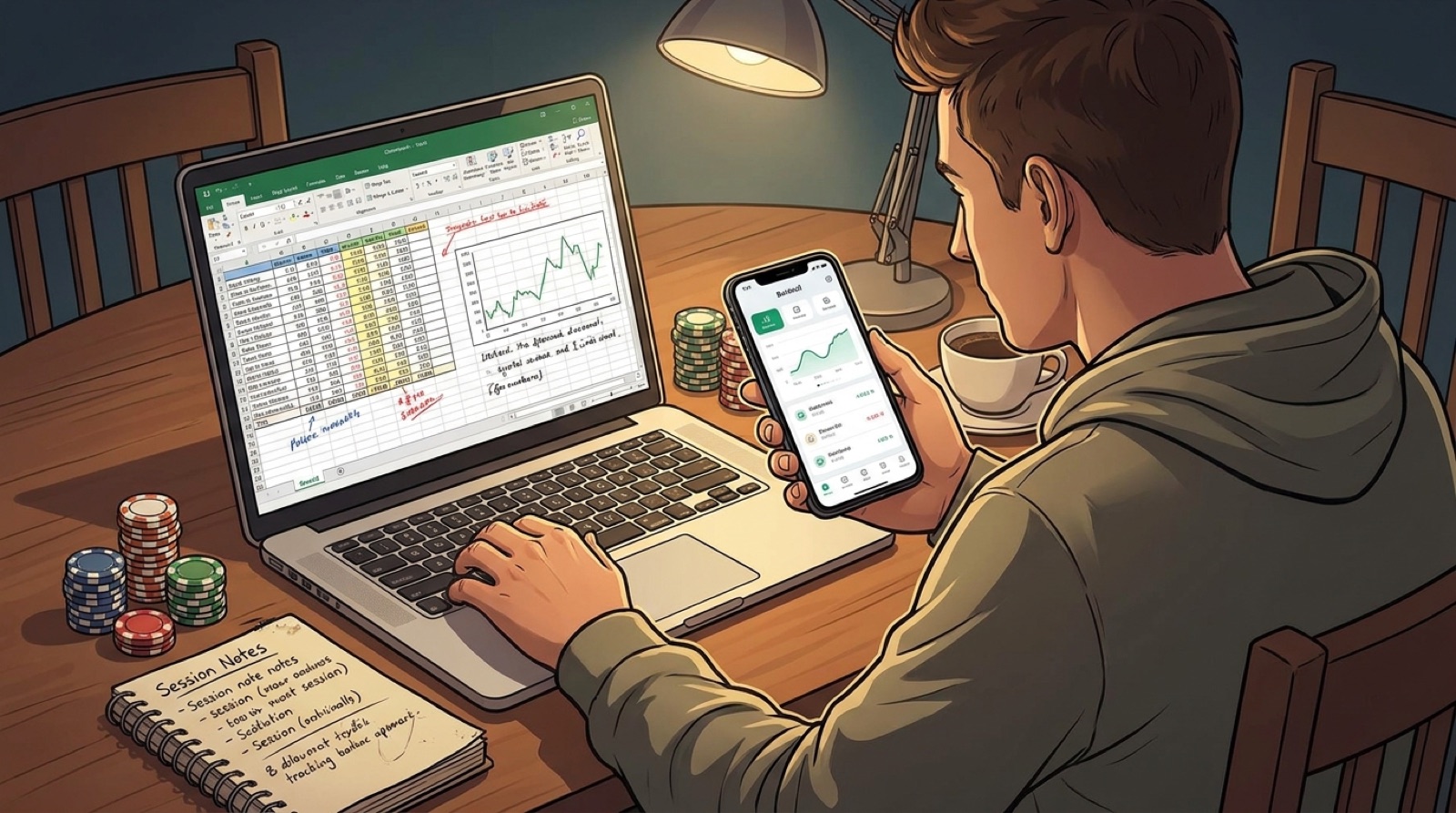
A poker bankroll app and a spreadsheet can both track the same basic thing: how much money you won or lost. The difference shows up after the session, when you are tired, annoyed, rushing to the cage, or trying to remember whether that second buy-in was $300 or $400.
That is where bankroll tracking gets honest. The best system is not the one with the prettiest formula. It is the one that captures your real poker history before your memory starts editing it.
Track your own results: The Poker bankroll tracker app guide explains what Poker Stack records, when an app beats a spreadsheet, and how to review sessions with less guesswork.
The short version
Use a spreadsheet if you want full control, custom formulas, and you are disciplined enough to update it every time. Use a dedicated poker bankroll app if you want faster mobile logging, cleaner session history, automatic charts, and less friction.
If your main problem is forgetting sessions, delaying entries, or only recording the result when it feels good, an app usually wins. If your main problem is building custom reports across many games and you enjoy maintaining the file, a spreadsheet can still work.
Comparison table
| Need | Spreadsheet | Poker bankroll app |
|---|---|---|
| Fast session entry | Fine at home, clumsy on the move | Built for logging right after play |
| Custom formulas | Excellent | Limited to the app's reports |
| Consistency | Depends on your habits | Lower friction, easier to repeat |
| Charts and filters | Powerful if you build them | Available without setup |
| Live poker use | Awkward during travel and late nights | Much better for mobile entry |
Where spreadsheets are still strong
Spreadsheets are not bad. A good Google Sheets or Microsoft Excel file can track stakes, hours, hourly rate, buy-ins, cash-outs, game type, travel costs, and notes. If you know formulas and pivot tables, you can make a serious poker tracking system.
The strength is flexibility. You can add columns for anything: straddles, table quality, rake, mood, hotel cost, backing, markup, re-entries, or whatever else matters to your game.
The weakness is the same thing. A spreadsheet asks you to design the system, maintain the system, and use the system. Most poker players are not bad at spreadsheets. They are bad at opening the spreadsheet after a rough eight-hour session.
Where a poker bankroll app wins
A poker bankroll app wins when tracking needs to be boring and repeatable. Open the app, log the session, add the result, move on. That sounds small, but it is the whole game.
Poker Stack is built around that habit. It is easier to log a session on your phone than to promise yourself you will update a file later. You can track results, see your bankroll trend, and review your poker history without rebuilding the tool from scratch.
This matters most for live poker players. If you play in different rooms, travel for tournaments, or mix cash games and events, you need a record that survives the night. We covered the practical session workflow in how to track live poker sessions without a spreadsheet.
The real test is memory
Most bad bankroll records do not fail because of math. They fail because of missing sessions.
A player loses $720 and says, "I will enter it tomorrow." Tomorrow becomes next week. Then the number gets rounded. Then the re-entry gets forgotten. Then the notes disappear. A month later, the graph looks cleaner than reality.
The same thing happens after winning sessions. A big win gets recorded immediately because it feels good. A boring loss gets delayed. That creates a fake picture of your results.
For a clean record, track every session the same way. Buy-in, cash-out, stakes, game type, place, time played, and one or two notes. The poker bankroll tracker app session recording guide explains what to capture after every session.

Download Poker Stack Now
"PokerStack is THE app you need to have as a live poker player."
Poker.com


What should you track?
At minimum, track the fields that help you review decisions later:
- Date and location
- Game type and stakes
- Buy-in and cash-out
- Hours played
- Profit or loss
- Short notes about game quality, tilt, fatigue, or major hands
If you play tournaments, add buy-ins, re-entries, add-ons, travel, and lodging. If you play cash, add table changes, straddles, and rake structure when it matters. The point is not to record your entire life. The point is to keep enough detail that future-you can see the pattern.
For more general tracking principles, the older Poker Stack guide to poker tracking is still a useful starting point.
External tools can help, but they do not replace your record
Bankroll tracking is separate from poker study. A tool like Primedope's poker variance calculator can show how ugly normal variance can get. A training site such as Upswing Poker can teach bankroll management ideas. A community discussion on Two Plus Two can help you compare habits with other players.
None of that tells you what happened in your last 80 sessions. Your own record does that. Without it, you are guessing whether you are running bad, playing bad, choosing bad games, or mixing all three.
When the spreadsheet is enough
A spreadsheet is enough if you already have a routine and trust it. If you update it on the same day, keep backups, use it on mobile without friction, and review it every week, there is no emergency.
Some players also need custom reporting that an app may not provide. If you are tracking a staking stable, splitting action, or building unusual reports, a spreadsheet may be the right base.
When you should switch to an app
Switch to an app when your spreadsheet has become a graveyard of good intentions. Common signs:
- You enter sessions days later.
- You remember wins better than losses.
- You stop updating the file when you are in a downswing.
- You have no quick view of bankroll trend by game or stake.
- You avoid reviewing results because the file feels like work.
If that sounds familiar, download Poker Stack and log the next session on your phone before you leave the room. Do not migrate your entire history first. Start with the next session. Build the habit, then decide whether to import or rebuild older records.
My practical recommendation
If you are a casual player who only plays a few times a year, a spreadsheet is fine. If you play regularly and care about your bankroll, use a poker bankroll app for daily logging and keep a spreadsheet only if you need extra analysis.
That split works well: the app captures reality, the spreadsheet can analyze it later. But the capture comes first. A perfect analysis file is useless if the inputs are missing.
Related Poker Stack reading
Poker bankroll tracker app: what to record after every session How to track live poker sessions without a spreadsheet
For broader app comparisons, read essential poker apps every player should have, then return to the Poker Stack blog for more bankroll and session-tracking guides.
Read our blog