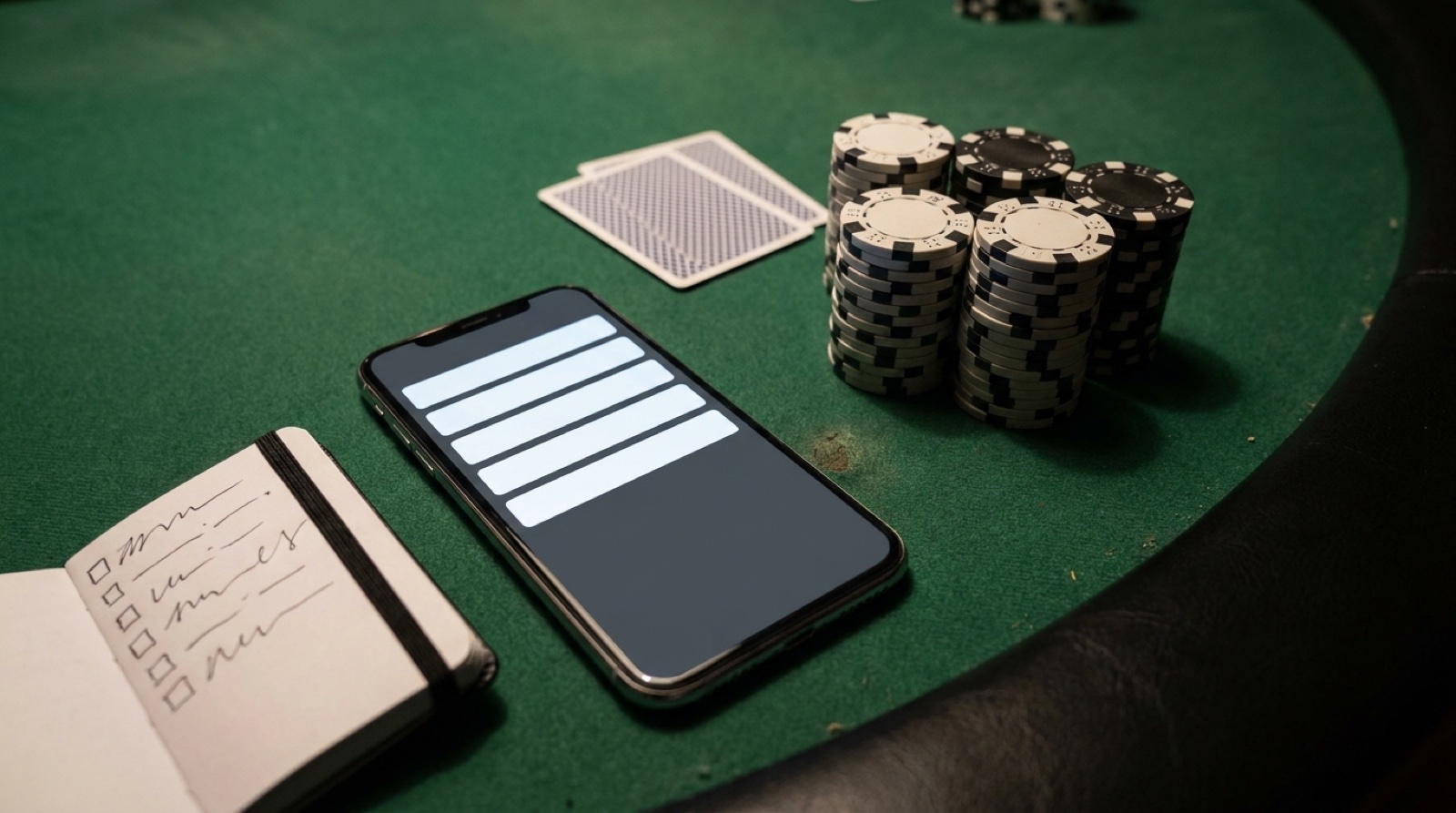
 Poker session notes app: what to write before you forget
Your first 10 poker sessions tracker entries are not there to prove you are a crusher. Ten sessions is tiny. It is too small for a win-rate verdict, too noisy for a life decision, and too emotional if the last one was a big loss.
But ten tracked sessions are enough to expose habits. You can see whether you are logging right away, playing the same stakes you planned, staying too long, taking sloppy shots, skipping notes, or turning every review into a story about variance.
Direct answer: After your first 10 tracked poker sessions, do not judge your win rate yet. Review your logging habit, stakes discipline, session length, game selection, notes quality, stop-loss behavior, and whether you can explain each result without guessing.
Start with the right expectation
The first mistake is treating a new poker session log like a scoreboard. If the first ten sessions are up, you feel validated. If they are down, you start shopping for a new strategy, a new stake, or a new excuse.
That is backwards. Early tracking is about building evidence. The question is not, "Am I good?" The question is, "Do I have a clean enough record to review how I actually play?"
This is why what you record after every poker session matters. Profit is one line. The useful story sits around it: buy-in, cash-out, stakes, game type, room, hours, expenses, notes, and the decision you want to review next time.
1. Did you log the session before memory rewrote it?
A session logged in the parking lot is different from a session reconstructed two days later. Memory protects the ego. It forgets the loose call, rounds down the extra rebuy, and turns a bad table into a cooler.
After ten sessions, check the timestamps and the detail level. If half the entries are late or vague, your first leak is not poker strategy. It is record quality.
A simple standard works: log the money and hours immediately, then add one or two notes before the session disappears from your head.
2. Are the stakes consistent?
New trackers often reveal stakes creep. One session starts at the planned game. The next is a little bigger because the lineup looked good. Then a tournament buy-in appears. Then a late-night shot gets filed as "standard" because nobody wants to admit it was boredom.
Your first ten sessions should show whether you are playing from a bankroll plan or from mood. If the stakes bounce around, separate planned shots from impulsive ones. The app cannot make that decision for you, but it can stop you from pretending the pattern is invisible.
3. Are long sessions helping or just adding risk?
One player wins over the first ten sessions but most of the profit comes from the first three hours. The last two hours are flat or ugly. On paper, the player is winning. In the log, the habit is obvious: staying too long turns good starts into fragile sessions.
Another player loses early but keeps session length controlled, avoids bad rebuys, and leaves when the game changes. That record might look worse in dollars and better in discipline.
Review hours with profit, not separately. A bankroll tracker is not just a cashier report. It should help you see when your edge fades.
4. Are you tracking game quality?
If your first ten entries only say "1/3 cash" or "online MTT," you are missing the part that decides a lot of your result. Was the table deep? Was the lineup aggressive? Were there obvious weak spots? Did the room change? Did you move tables when the game got bad?
This is where a tracked record beats memory. You can review whether losses came from bad games, bad play, or normal swings. You can also spot the quiet win: maybe you lost money but kept choosing good games and avoided chasing.
The poker tool stack for live players starts here. Record the table context before you add more apps, calculators, or study tools.
5. Do your notes say anything you can act on?
"Ran bad" is not a note. "Played bad" is not much better. A useful note names the review target: called river too light against a passive player, played too many hands after moving to a bigger game, skipped a table change when two good seats left, or lost focus after the second rebuy.
After ten sessions, scan the notes without looking at profit first. If the same theme appears three times, you have a study target. If the notes are empty, you do not have a review habit yet.
That is the real value of a poker session notes app: it gives tomorrow-you enough detail to make one better decision.

Download Poker Stack Now
"PokerStack is THE app you need to have as a live poker player."
Poker.com


6. Are you using stop-loss rules or negotiating with them?
A stop loss that changes mid-session is not a stop loss. It is a suggestion. Your first ten tracked sessions should show whether you leave when the plan says to leave or whether you add a story every time the number hurts.
Look for the sessions where the loss got bigger after the first clear exit point. Those entries are expensive because they show the exact moment bankroll management became emotional.
If this is your pattern, the next step is not a complicated model. It is a clear rule before you sit down, then honest logging when you break it.
7. Are you confusing variance with a lack of records?
Variance is real. Ten sessions still cannot prove your true win rate. But variance should not become a blanket excuse for a messy log.
If you do not know your hours, stakes, rebuys, table quality, and notes, you are not analyzing variance. You are arguing with a memory that wants to feel better.
Use the bankroll tracker vs variance calculator guide for the right split: tracker first for evidence, calculator later for expectations. For a quick outside model, a tool such as the Primedope poker variance calculator can show how wide normal short-term results can be.
A simple ten-session review
When you have ten tracked sessions, run this review before judging your poker life:
- Count how many sessions were logged the same day.
- Check whether stakes matched the bankroll plan.
- Compare profit with hours, not just session result.
- Tag the best and worst games by lineup quality.
- Find the most repeated note or leak.
- Mark every session where you broke a stop-loss or shot-taking rule.
- Pick one adjustment for the next ten sessions.
The adjustment should be boring and measurable. Leave after five hours. Stop taking unplanned shots. Add one useful note per session. Review the same stake for ten more entries. Boring is good. Boring gives you data. General bankroll management guidance from Upswing Poker makes the same practical point: stake choices need a plan before results get emotional.
What to learn from winning first ten sessions
If you are up after ten sessions, enjoy it, then calm down. The useful question is whether the win came from repeatable behavior. Did you play good games? Did you quit well? Did you keep stakes consistent? Did you log the details?
A winning record with sloppy habits is fragile. A winning record with clean notes gives you something to repeat.
What to learn from losing first ten sessions
If you are down after ten sessions, do not rush to change everything. Start by separating process from result. Maybe you played good games and ran into normal short-sample pain. Maybe you played tired, moved stakes, and called it variance. The basic statistics idea of sample size is the boring reason ten sessions should start a review, not end one.
The record should make that conversation less emotional. If it does not, your next goal is better tracking, not bigger conclusions.
The real goal: the next ten sessions
Your first ten tracked poker sessions are a baseline. The second ten are where the habit starts to matter. You are not trying to prove genius. You are trying to stop guessing.
Install Poker Stack from the App Store before your next session, log the details while they are fresh, and review the next ten sessions as a pattern instead of a pile of memories.
Related Poker Stack reading
Poker session notes app: what to write before you forget Poker win rate sample size: when your results start to mean something
Read our blog