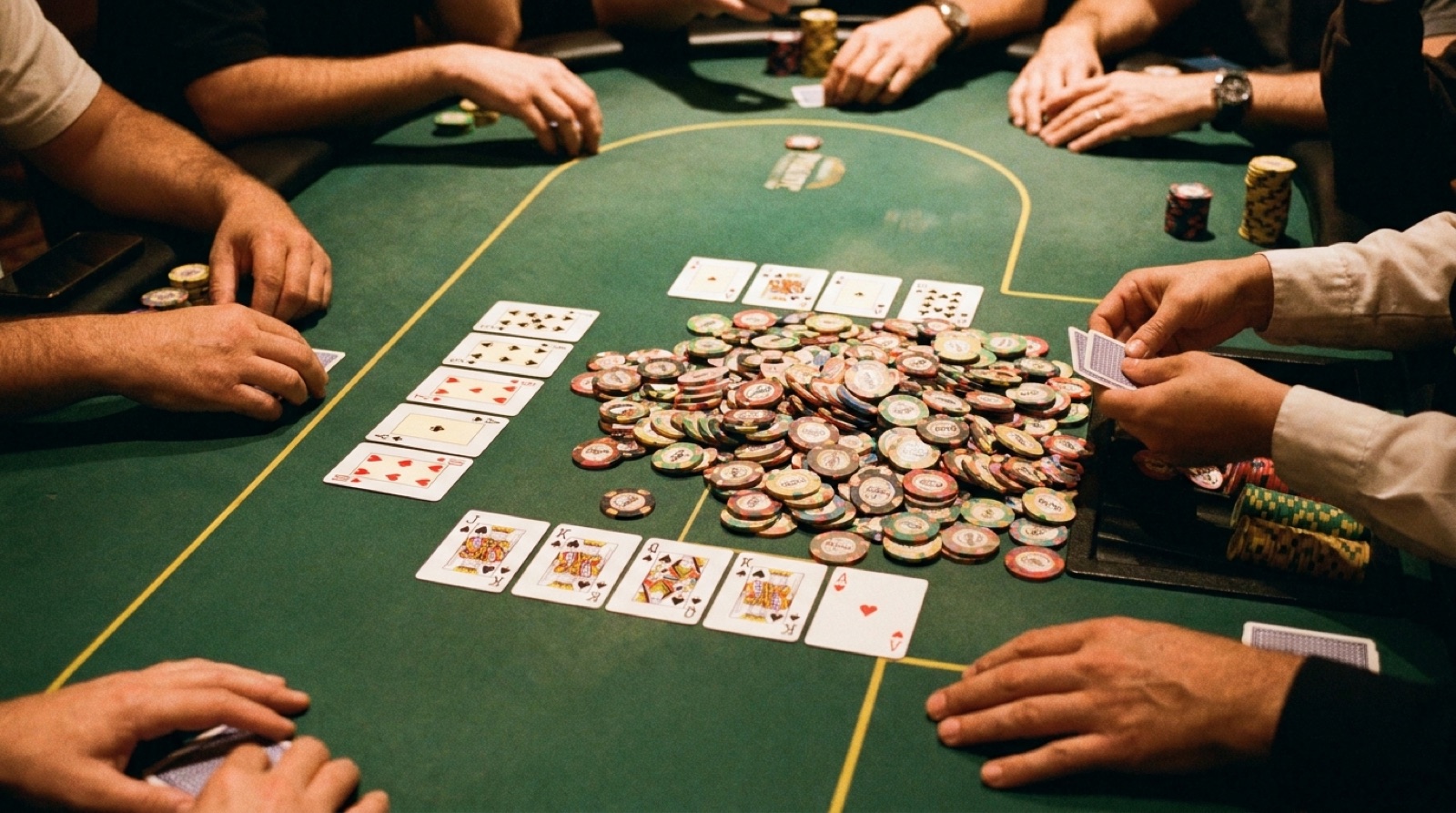
Double board bomb pot strategy starts with one brutal rule: half the pot is not enough. In a normal hand, winning one board feels fine. In a bomb pot, especially in PLO or PLO5, playing for a chop while someone else can scoop is how a fun hand turns into a bankroll leak.
Bomb pots are popular because they create action without the usual preflop routine. Everyone puts in a fixed amount, the dealer runs the flop, and the hand starts with a bloated pot. In double board bomb pots, there are two boards. The final pot is usually split between the best hand on each board, unless one player wins both.
Direct answer: what wins in double board bomb pots?
The best double board bomb pot hands can win both boards or freeroll one board while already holding strong equity on the other. You want nut draws, redraws, connected cards, suited cards, and hands that can make the nuts in more than one way. Weak one-board hands and non-nut made hands are dangerous because they often fight for only half the pot.
The biggest leak is chasing half
The classic mistake is thinking, "I have top two on one board, so I cannot fold." That hand may look strong, but it can be a trap if the second board gives you nothing and the first board is full of straight and flush pressure.
In a $1,000 pot, winning half gets you $500. If you are calling big bets just to maybe get your money back, you are not printing. You are volunteering for rake, variance, and awkward river decisions.
A better question is simple: can this hand scoop, or am I hoping for mercy?
Think in scoop equity, not hand strength
Normal poker thinking asks, "How strong is my hand?" Bomb pots ask, "How many ways can this hand win the whole thing?" That shift matters.
A bare set on one board can be worse than a wrap plus nut flush draw that touches both boards. A weak made straight on one board can be fragile if it has no redraw and no second-board equity. A hand that looks messy can become premium if it has live outs across both boards.
This is why Hold'em instincts break down. Pair-plus-kicker poker is too small for double board pots. You need nut potential, blockers, and redraws.
Hands that play well in double board bomb pots
Good bomb pot hands usually share a few traits. They connect across ranks. They have suitedness. They can make nut straights or nut flushes. In Omaha formats, they avoid dangling cards that do nothing.
Hands with A-K-Q-J type structure, double-suited connected rundowns, and high-card connectivity tend to perform better than random big cards. Low connected cards can work too, but only when they are not drawing to dominated straights or weak flushes.
The goal is not to make any hand. The goal is to make the kind of hand that can survive a pot-sized bet when the table is staring at two boards full of trouble.
Hands that quietly burn money
The bad hands are the ones that look playable because one board likes them. Top pair on one board and air on the other is usually junk. Bottom two pair with no redraw is a headache. A non-nut flush draw on one board and nothing on the other can be a donation.
Dry overpairs are especially easy to overvalue. In a normal Hold'em hand, aces can win unimproved. In a multi-way bomb pot, aces are often just one pair in a pot where someone has two boards to attack.
If your hand cannot improve into the nuts and cannot compete on the other board, folding earlier is often the disciplined play.
Position becomes even more valuable
Position is powerful in every poker format, but double board bomb pots make it feel unfair. When you act last, you see how many players still care. You can tell whether a bet is likely one-board protection, a real scoop attempt, or a player stabbing at dead money.
Out of position, you are guessing into several players and two boards. That creates expensive mistakes. You check, someone bets, another player calls, and now you have to decide whether your one-board hand is alive or already trapped.
When you are early to act, tighten your continuing range. Do not pay premium prices with hands that only have medium equity and no clean path to scoop.
Betting should tell a scoop story
Big bets in double board bomb pots should usually come from hands that can win both boards, deny equity, or freeroll. If you bet big with only one-board strength, better players can punish you by raising with scoop-heavy hands or calling correctly with hands that have cleaner equity.
Small bets can make sense when you want value from weaker one-board hands, but they also invite the whole table to realize equity. In bloated pots, that can get ugly fast.
Before betting, ask what worse hands call and what better hands raise. If the answer is ugly, checking may save you a buy-in.
The freeroll is the dream spot
A freeroll happens when you are very likely to win one board and still have outs to win the other. This is where bomb pot money comes from. You are not just chopping. You are locking up part of the pot while taking shots at the rest.
Example: you have the nut straight on one board and the nut flush draw on the other. Another player may be stuck calling because they also have the straight on the first board, but they cannot win the second board when your flush arrives. That is the kind of pressure spot you want to create.
If you are on the wrong side of the freeroll, be careful. Calling because "we probably chop" is exactly how the other player gets paid.
Bankroll tracking matters more in bomb pot games
Bomb pots make sessions swingy. You can play well and still take a violent hit when two boards run against you. You can also scoop a huge pot and think you are playing better than you are.
This is where Poker Stack helps. Track bomb pot sessions separately when you can. Add notes about game type, stack depth, and whether the table was playing double board PLO, Hold'em, or mixed formats. Over time, you will see whether the action game is actually profitable or just exciting.
A simple double board bomb pot checklist
- Can my hand win both boards?
- Do I have nut draws or only pretty-looking weak draws?
- Am I calling to scoop or just praying to chop?
- Does my position let me control the price?
- Could another player be freerolling me?
- Is this table loose enough that I need a stronger continuing range?
That checklist will not solve every spot, but it keeps you from making the most expensive mistake: treating a bomb pot like a normal raised pot.
Final thought
Double board bomb pots reward players who think bigger than one board. The money goes to hands that can scoop, freeroll, and apply pressure with nut equity. If your hand is only trying to survive half the pot, it is probably weaker than it feels.
Related Poker Stack reading

Pot Limit Omaha vs. Texas Hold'em
A beginner transition guide for players moving from Hold'em into Omaha formats.