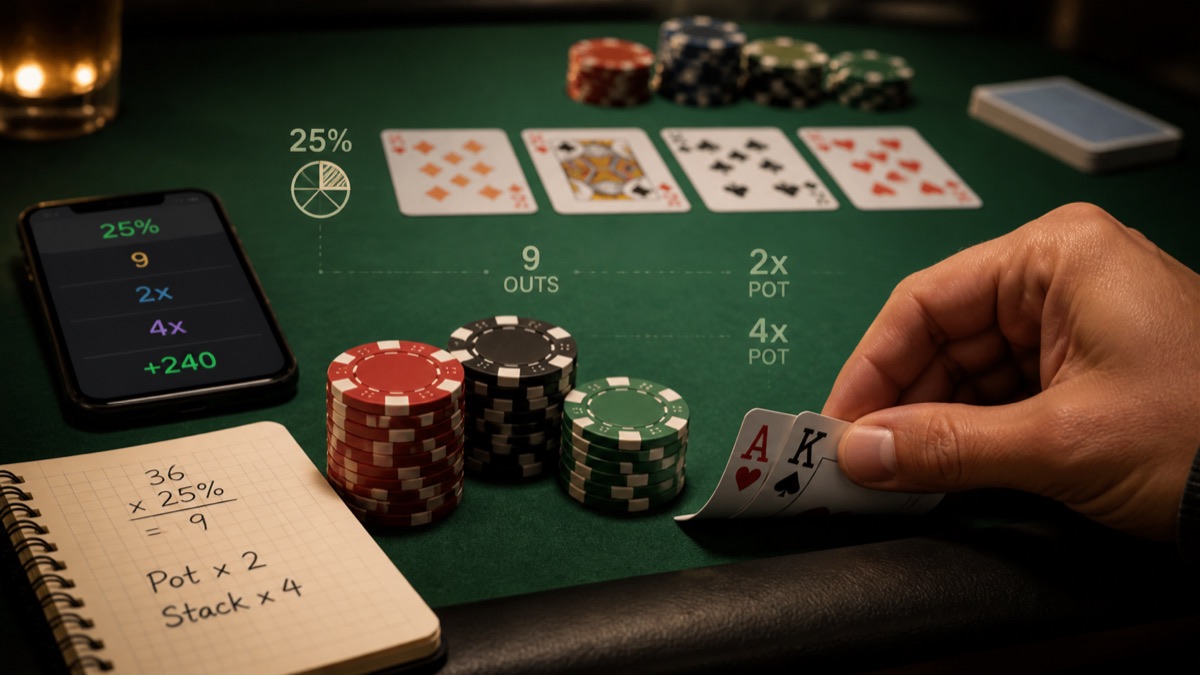
Poker is full of people who know the right concept but lose time when the numbers arrive. They know pot odds matter. They know outs matter. They know stack depth changes decisions. Then the dealer is waiting, two players are staring, and the pot has become a pile of chips instead of a clean number on a screen.
You do not need to become a human calculator. You need a small set of poker numbers that feel automatic. The goal is not perfect math. The goal is being close enough, fast enough, while the hand is still moving.
This is also why mental math belongs beside your tracking routine. A poker bankroll tracker tells you what happened over time. Mental math helps you make cleaner decisions before the result becomes another line in the log.
Start with pot odds
The pot odds formula is simple:
Amount to call ÷ final pot after you call = equity needed
If the pot is $80 and villain bets $40, you are calling $40 to win a final pot of $160. That means $40 ÷ $160 = 25%. You need about 25% equity to call before considering future action.
At the table, do not chase decimals. Train the common shapes until they are familiar:
- Call $25 into a final pot of $100: you need 25%.
- Call $50 into a final pot of $200: you need 25%.
- Call $30 into a final pot of $150: you need 20%.
- Call $75 into a final pot of $300: you need 25%.
- Call $100 into a final pot of $500: you need 20%.
When these patterns are automatic, a live bet stops feeling like pressure and starts looking like a price.
Know your outs without overthinking them
The fastest rough estimate is the rule of 2 and 4:
- After the flop, multiply your outs by 4 to estimate equity by the river.
- After the turn, multiply your outs by 2 to estimate equity by the river.
Nine flush outs on the flop is roughly 36% by the river. Eight open-ended straight outs is roughly 32%. Four gutshot outs is roughly 16%. These are estimates, not a replacement for deeper study, but they are useful under time pressure.
If you want the fuller concept, read our guide to understanding poker equity. The mental math layer is what lets you use that equity quickly in a live spot.
Practice break-even bluff and call math
Break-even math shows how often a play has to work. It is one of the cleanest ways to stop judging bluffs only by whether they won this time.
Bet size ÷ pot after your bet = break-even fold frequency
If the pot is $100 and you bet $50, your bluff risks $50 to win a final pot of $150. It needs to work about 33% of the time.
Again, memorize the shapes:
- Half-pot bluff: needs to work about 33%.
- Two-thirds-pot bluff: needs to work about 40%.
- Pot-sized bluff: needs to work about 50%.
- One-third-pot bluff: needs to work about 25%.
You still need player reads, board texture, blockers, and range logic. But break-even math gives the decision a floor. Without that floor, many players underbluff because they remember the pain of getting called more clearly than the price of the bet.
Convert everything into big blinds
Live poker gets messy because money feels personal. Big blinds make stacks easier to compare across stakes.
- $300 in a $1/$3 game is 100 big blinds.
- $500 in a $2/$5 game is 100 big blinds.
- $1,000 in a $5/$10 game is 100 big blinds.
- A $75 pot at $1/$3 is 25 big blinds.
- A $250 pot at $2/$5 is 50 big blinds.
That habit helps your session notes too. If you review only dollars, moving stakes can distort your thinking. If you also log stack depth and big blinds, you can compare decisions more cleanly over time.
Keep stack-to-pot ratio simple
Stack-to-pot ratio, or SPR, is just effective stack divided by the pot. You do not need a lab report. You need a quick feel for how committed stacks are becoming.
Effective stack ÷ pot = SPR
If the pot is $100 and the effective stack behind is $400, the SPR is 4. If the pot is $100 and the stack behind is $1,000, the SPR is 10.
Low SPR spots reward strong made hands and simpler commitment decisions. High SPR spots create more room for implied odds, pressure, and mistakes on later streets. If you know the rough SPR, you can avoid treating every top pair or draw the same way.
Train the numbers outside the session
Mental math gets worse when you only practice it during emotional hands. Use a separate, low-friction practice habit so the arithmetic itself becomes boring.
That is where a fast mental math game like Tally Rush fits naturally. It is not a poker solver and it will not teach you ranges. But short arithmetic rounds help train the speed and comfort you need for pot sizes, bet fractions, percentages, buy-ins, and big blind conversions.
A useful practice session can be simple:
- Spend a few minutes on fast addition and subtraction.
- Practice multiplying outs by 2 and 4.
- Convert common bet sizes into percentages.
- Turn stacks into big blinds at the stakes you play most.
- Review one recent Poker Stack session and write down the math spots you hesitated on.
Review the math after the session
The best time to catch weak mental math is during review. After each session, choose one or two hands where the number felt unclear. Do not rewrite the whole night. Just answer:
- What was the pot before the bet?
- What was the amount to call?
- What equity did the call need?
- How many clean outs did you really have?
- Was stack depth low, medium, or high?
Then log the session while the details are still usable. Poker Stack is built for that rhythm: finish the session, record the result, then add enough context to make the next review meaningful.
Related reading


Bottom line
Poker mental math should make the game quieter. You see the pot, know the price, estimate the outs, understand the stack depth, and move on. The less attention you spend on arithmetic, the more attention you have for people, ranges, table dynamics, and your bankroll plan.
Track the result in Poker Stack. Practice the arithmetic away from the table. Bring the cleaner decision back to the next session.
Track your poker bankroll without a spreadsheet
Log sessions, see your profit and loss, review your poker results, and keep your bankroll decisions grounded in real data.